

Automotive Night Vision System Market to Hit USD 9.55 Billion by 2035 at 10.5% CAGR, Driving Demands, Size, and Trends
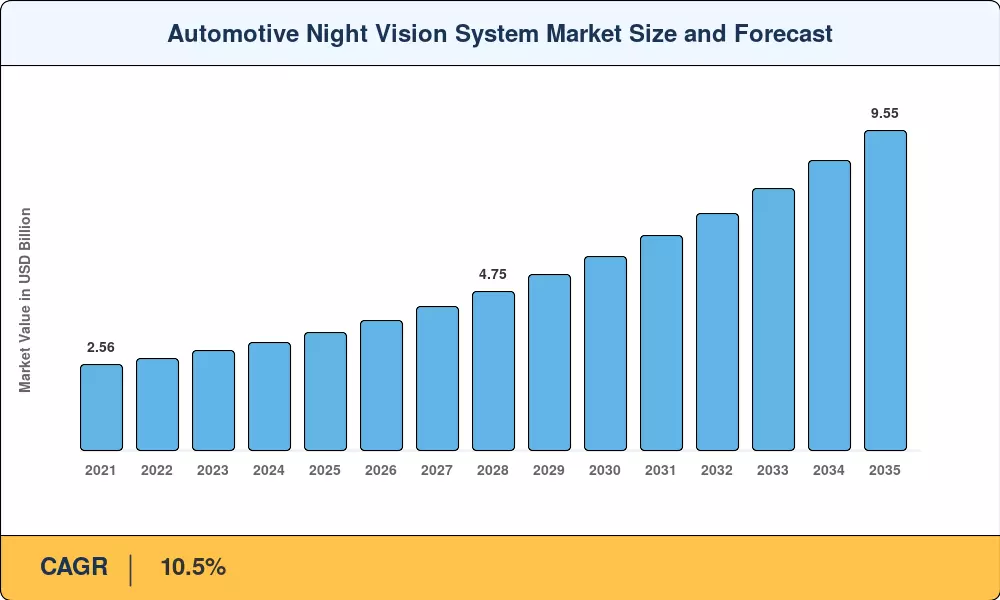
Automotive Night Vision System Market Summary
North America led the Automotive Night Vision System Market with 37.5% revenue share in 2025, driven by FMVSS No. 127 compliance timelines.
Far Infrared (LWIR) technology held 58.4% of the Automotive Night Vision System Market share in 2025, reflecting its passive detection advantage and lower component complexity.”
NY, CA, UNITED STATES, July 3, 2026 /EINPresswire.com/ -- The Automotive Night Vision System Market was valued at USD 3.52 billion in 2025 and is projected to reach USD 3.89 billion in 2026 before climbing to USD 9.55 billion by 2035, registering a CAGR of 10.5% during the forecast period (2026–2035).— Arti Dhapte
Automotive Night Vision System Market Overview
The automotive night vision system market trends represents an advanced driver assistance technology that significantly enhances a vehicle's ability to detect and display objects in low-light or challenging visibility conditions. By utilizing infrared sensors, thermal imaging cameras, and sophisticated image processing algorithms, these systems detect pedestrians, animals, and obstacles beyond the range of standard headlights, projecting enhanced images onto displays for the driver . Modern night vision systems provide critical early warnings that extend a driver's effective visual range by several hundred meters, offering vital reaction time to avoid collisions .
The market is experiencing robust growth driven by the convergence of rising nighttime road accidents and stringent safety regulations. The U.S. Federal Highway Administration reports significantly higher fatality rates at night, reinforcing the need for improved visibility technologies . This safety imperative, combined with regulatory encouragement for advanced driver assistance systems (ADAS), is compelling automakers to integrate night vision capabilities into comprehensive safety packages . As a result, night vision systems are transitioning from niche luxury options to essential low-light perception components.
Industry trends indicate a decisive shift toward deeper integration with ADAS and autonomous driving platforms. System architects are moving from isolated night-vision modules toward fused perception platforms that combine thermal sensors with radar, lidar, and visible cameras . This sensor fusion approach enhances redundancy and enables higher confidence detections, which support higher-level driver assistance features. The integration of AI-powered image recognition allows for more accurate target identification and automated alerts, greatly enhancing the intelligent driving experience and reducing false positives .
Technological developments are reshaping the night vision landscape at an unprecedented pace. Uncooled thermal sensors have matured beyond lab-grade systems, with optimized optics delivering reliable object detection at a fraction of earlier cost and complexity . Advances in neural networks and edge computing have elevated the viability of persistent object classification and trajectory prediction within the vehicle's perception stack. Night vision cameras are witnessing improvements in resolution, thermal sensitivity, and durability, resulting in clearer images and enhanced object detection accuracy across diverse road environments .
Policy and regulatory influence on the automotive night vision market is substantial. Governments and safety agencies are increasingly encouraging or mandating the adoption of ADAS features, indirectly supporting night vision system adoption as part of broader vehicle safety packages . The European Union's focus on pedestrian and cyclist protection, along with China's GB/T standards for advanced emergency braking, creates compliance-driven demand for night vision capabilities . Regulatory attention to nighttime road fatalities has intensified, prompting certification programs and incentive structures that favor proven night-vision capabilities .
The demand outlook for automotive night vision systems remains exceptionally strong. North America leads the market due to high consumer awareness of vehicle safety technologies and significant nocturnal wildlife activity, particularly deer crossings on rural roads . Europe remains a significant market due to stringent vehicle safety regulations and high penetration of premium vehicles . Asia-Pacific emerges as the fastest-growing region, fueled by rapid automotive production growth in China, Japan, and South Korea, with domestic luxury brands incorporating night vision into premium offerings .
📍 Get Free Sample Report for Detailed Market Insights:
https://www.marketresearchfuture.com/sample_request/5124
Automotive Night Vision System Market Segmentation
By Technology Type
The automotive night vision system market is segmented by technology type into Far Infrared (LWIR), Near Infrared (NIR), and Short-Wave Infrared (SWIR). Thermal imaging (far infrared) dominates the market due to its superior detection capability and reliable performance in poor light conditions . Passive thermal systems operate using thermal sensing without emitting light, improving stability and ADAS compatibility and providing consistent performance in complete darkness . Near-infrared systems complement thermal sensing by offering higher-contrast imaging for certain pedestrian and animal detection scenarios, enabling hybrid sensor arrays that expand operational envelopes . Short-wave infrared systems represent an emerging segment with specialized applications in enhanced object detection.
By Display Type
Display type segmentation includes Head-Up Display (HUD), Instrument Cluster, Central Infotainment Screen, and Navigation System. HUDs dominate the market as they project alerts directly within the driver's line of sight, strengthening road safety and adoption across regions . HUD integration enhances visibility without distracting drivers and aligns night vision functionality with evolving digital cockpit strategies. Instrument cluster displays remain widely adopted due to seamless compatibility with digital dashboards, offering a cost-effective interface for night vision imagery across multiple vehicle platforms . Central infotainment screens and navigation systems are increasingly used to combine night vision imagery with maps and ADAS information.
By Component Type
Component type segmentation covers Night Vision Cameras, IR Illumination Sources, Image Processing ECUs, and Display Modules. Night vision cameras account for the largest component segment as they form the core sensing hardware . Continuous improvements in resolution, thermal sensitivity, and durability support higher system pricing and broader adoption. Image processing ECUs are evolving with higher processing power and advanced image processing capabilities, enabling real-time analysis of infrared data and faster system response . Software and algorithms represent the fastest-growing segment, driven by AI integration for enhanced image clarity and object recognition .
By Vehicle Type
Vehicle type segmentation includes Passenger Cars, Light Commercial Vehicles, and Heavy Commercial Vehicles. Passenger cars represent the largest segment as luxury and premium vehicles continue to account for the majority of night vision system installations . SUVs dominate due to strong association with advanced safety features and higher price positioning . Commercial vehicles and fleet operators are increasingly exploring night vision systems to improve nighttime safety, particularly for long-haul trucking operations where extended driving hours and low-light conditions increase accident risk . Luxury vehicles are expected to witness the highest growth rate as premium automakers differentiate their flagship models through advanced safety technologies .
By Sales Channel
Sales channel segmentation includes OEM Factory-Fit and Aftermarket. OEM sales dominate the market as factory-installed systems ensure seamless integration with vehicle electronics and ADAS platforms . Aftermarket penetration remains limited due to calibration complexity and high cost, though retrofit systems are emerging as a growth segment for fleet operators and owners of older vehicles seeking enhanced safety capabilities .
🛒 You can buy this market report at:
https://www.marketresearchfuture.com/checkout?currency=one_user-USD&report_id=5124
Automotive Night Vision System Market Regional Analysis
North America
North America holds a leading position in the automotive night vision system market, driven by high consumer awareness of vehicle safety technologies and the strong presence of luxury automotive brands . The U.S. market benefits from strong consumer preference for advanced safety features and increasing deployment of intelligent vehicle technologies . The region's extensive highway network and significant nocturnal wildlife activity, particularly deer crossings on rural roads, create practical demand for early hazard detection systems . Favorable insurance premium adjustments for vehicles equipped with advanced collision avoidance systems incentivize both automakers and consumers . The U.S. mandates ongoing improvements in pedestrian safety standards, indirectly supporting night vision adoption.
Europe
Europe remains a significant market for automotive night vision systems due to stringent vehicle safety regulations, high penetration of premium vehicles, and strong OEM focus on deploying advanced driver assistance technologies . Germany dominates the European market, driven by a strong concentration of premium OEMs that prioritize advanced safety and technology differentiation . European OEMs are increasingly integrating night vision systems with pedestrian and cyclist detection features, reflecting regional priorities around vulnerable road user protection . The transition toward fully digital instrument clusters and augmented head-up displays across Europe supports broader adoption of night vision visualization solutions . Germany, France, and the UK lead regional adoption.
Asia-Pacific
Asia-Pacific emerges as the fastest-growing region for automotive night vision systems, fueled by rapid automotive production growth, rising disposable incomes, and increasing safety consciousness among consumers . China, Japan, and South Korea lead regional adoption, with domestic luxury brands incorporating night vision into premium offerings and European manufacturers transferring technology to their Asian assembly plants . China's market is projected to be one of the largest, with 2025 revenue representing roughly 21.9% of global sales . India shows growing adoption with a 2025 market value of approximately USD 0.09 billion . Government initiatives promoting ADAS and pedestrian protection regulations accelerate deployment across the region .
Rest of the World
The Rest of the World segment, encompassing South America and the Middle East and Africa, shows gradual but improving growth as commercial vehicle and passenger car manufacturers adopt more safety technologies. Adoption remains selective due to high costs, but expanding safety awareness supports future potential . Saudi Arabia's Vision 2030 automotive localization program and the UAE's smart-mobility initiatives generate nascent demand for advanced safety technologies. Latin American markets, particularly Brazil, show gradual adoption driven by growing awareness of road safety and improving economic conditions.
To explore more market insights, visit us at:
https://www.marketresearchfuture.com/reports/automotive-night-vision-system-market-5124
Latest Industry News & Developments
In a significant technology development, Omnivision won the AI-Semiconductor accolade at the Singapore Business Review Technology Excellence Awards in April 2026 for its OAX4600, the automotive industry's first fully integrated, AI-enabled ASIC designed to simultaneously execute complex driver monitoring and occupant monitoring tasks via infrared and low-light vision streams .
Smart Eye AB secured a breakthrough order with a major Japanese automotive manufacturer in April 2026 to supply its Interior Sensing AI software for two upcoming vehicle models launching in mid-2027, leveraging advanced eye-tracking and multi-modal software to log activity and safety metrics across the entire cabin .
Magna International announced a multiyear partnership valued above USD 150 million with a leading Chinese electric vehicle manufacturer in January 2025 to supply integrated night vision and ADAS systems for three premium EV models launching in late 2025 . This partnership strengthens Magna's presence in China's fast-growing premium electric vehicle segment.
Teledyne FLIR introduced upgraded automotive-qualified thermal modules in June 2024, designed for improved detection performance and scalable OEM integration, supporting broader deployment of thermal imaging technology .
More Related Reports from MRFR Library:
https://www.marketresearchfuture.com/reports/vehicle-camera-market-1953
https://www.marketresearchfuture.com/reports/automotive-alternator-market-1973
https://www.marketresearchfuture.com/reports/automotive-bearing-market-1996
https://www.marketresearchfuture.com/reports/automotive-metal-stamping-market-2002
https://www.marketresearchfuture.com/reports/driver-safety-market-2007
https://www.marketresearchfuture.com/reports/automotive-front-end-module-market-2016
https://www.marketresearchfuture.com/reports/biometric-vehicle-access-market-2032
https://www.marketresearchfuture.com/reports/vehicle-anti-theft-market-2036
https://www.marketresearchfuture.com/reports/automotive-glass-market-2045
https://www.marketresearchfuture.com/reports/hybrid-power-solution-market-2053
Larry Wilson
WantStats Research And Media Pvt. Ltd.
+1 855-661-4441
email us here
Visit us on social media:
LinkedIn
Facebook
YouTube
X
Legal Disclaimer:
EIN Presswire provides this news content "as is" without warranty of any kind. We do not accept any responsibility or liability for the accuracy, content, images, videos, licenses, completeness, legality, or reliability of the information contained in this article. If you have any complaints or copyright issues related to this article, kindly contact the author above.
