

The Evolution of the Automotive Wire and Cable Material Market: A Decade of Transformation (2025–2035)
Automotive Wire & Cable Material Market
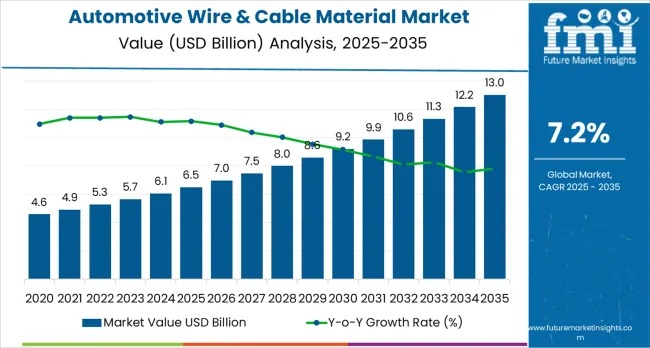
The automotive wire & cable material market is projected to grow from USD 6.5 billion in 2025 to USD 13.0 billion by 2035, at a CAGR of 7.2%.
NEWARK, DE, UNITED STATES, January 28, 2026 /EINPresswire.com/ -- The global automotive wire and cable material market is projected to expand from USD 6.5 billion in 2025 to approximately USD 13 billion by 2035. This represents a staggering 101.5% total growth over the decade, advancing at a CAGR of 7.2%. This surge is not merely a byproduct of increased vehicle production; it is a fundamental reaction to the soaring electronic complexity required by the modern mobility ecosystem.
The global automotive landscape is undergoing its most significant shift since the invention of the assembly line. As the industry pivots from internal combustion engines (ICE) toward a future defined by electrification, autonomy, and hyper-connectivity, the "nervous system" of the vehicle—its wiring and cabling—is being completely reimagined.
The Electrification Catalyst
The primary engine behind this market’s growth is the rapid adoption of Electric Vehicles (EVs). From a wiring perspective, the difference between an ICE vehicle and a Battery Electric Vehicle (BEV) is profound.
• Wiring Volume: While a traditional car contains about 1.5 to 2 kilometers of wiring, a modern EV often requires 3 to 5 kilometers. This expansion is driven by the need for high-voltage battery systems, sophisticated thermal management, and power electronics.
• High-Voltage Requirements: Unlike the standard 12V systems of the past, EVs operate on architectures ranging from 400V to over 800V. This necessitates specialized high-performance materials capable of handling high currents and extreme temperatures without degrading.
• Charging Infrastructure: Beyond the vehicle itself, the materials used in EV charging cables—which must be durable, weather-resistant, and flexible—are contributing to the overall market value.
Request For Sample Report | Customize Report | Purchase Full Report
https://www.futuremarketinsights.com/reports/sample/rep-gb-1676
Material Dynamics: The Reign of PVC and the Rise of Alternatives
In 2025, Polyvinyl Chloride (PVC) remains the dominant insulation material, holding a 48.4% market share. Its popularity stems from its excellent electrical insulation properties, mechanical durability, and cost-effectiveness. However, the next decade will see a shift in material preferences.
The Move Toward Halogen-Free Materials
Stringent environmental regulations, particularly in Europe, are pushing manufacturers away from traditional PVC toward Halogen-Free Flame Retardant (HFFR) materials. In the event of a fire, halogen-free materials do not release toxic gases, enhancing occupant safety.
Advanced Polymers
• Cross-Linked Polyethylene (XLPE): Growing in popularity for high-voltage applications due to its superior thermal resistance.
• Thermoplastic Polyurethane (TPU): Favored for sensor and data cables where flexibility and abrasion resistance are paramount.
• Polypropylene (PP): Being adopted for low-voltage insulation as a lightweight alternative to PVC.
Lightweighting: The Weight of the "Nervous System"
One of the most significant challenges in modern automotive design is weight management. As vehicles add more features, they become heavier, which negatively impacts fuel efficiency and EV range. The wiring harness is often the third heaviest component in a vehicle, behind the engine and the chassis.
To combat this, the industry is witnessing a transition from copper to aluminum conductors. While copper offers superior conductivity, aluminum provides roughly 50% weight savings. By utilizing aluminum for larger power cables and optimizing insulation thickness with advanced polymers, engineers can shed significant weight without sacrificing performance.
Connected and Autonomous Technologies
The push toward Software-Defined Vehicles (SDVs) and Autonomous Driving is creating a new segment within the market: high-speed data transmission materials.
• ADAS Integration: Advanced Driver Assistance Systems (ADAS) rely on a network of cameras, radar, and lidar. These sensors generate massive amounts of data that require high-bandwidth cables (such as automotive Ethernet and shielded twisted pairs) to maintain signal integrity in electromagnetically noisy environments.
• V2X Communication: Vehicle-to-Everything (V2X) technology requires robust communication wiring to facilitate real-time data exchange between the vehicle and its surroundings, further increasing the "wire count" per car.
Segmental and Regional Outlook
Passenger Vehicles: The Dominant Segment
In 2025, passenger vehicles are estimated to account for 52.7% of the market share. This is driven by the sheer volume of global production and the trend of "premiumization," where even entry-level cars now feature advanced infotainment and safety tech previously reserved for luxury models.
Regional Leaders: Asia-Pacific at the Forefront
The growth of the market is heavily concentrated in the Asia-Pacific region:
• China (8.5% CAGR): As the global leader in EV production, China’s demand for high-voltage and specialized cable materials is unmatched.
• India (9.2% CAGR): Projected to be the fastest-growing market, India is benefiting from a massive domestic automotive manufacturing expansion and government initiatives like the Production Linked Incentive (PLI) scheme.
• United States and Germany: Both regions remain critical hubs for innovation, particularly in high-voltage 800V architectures and sustainable material development.
Key Players in the Automotive Wire & Cable Material Market
The global landscape is defined by a strategic partnership between specialized wiring harness manufacturers and chemical giants providing advanced insulation materials. Key participants include:
• Sumitomo Electric: A leader in the development of high-voltage harnesses and aluminum wiring technology designed to reduce vehicle weight.
• Yazaki Corporation: Recognized as a global leader in comprehensive wiring harness assembly and integrated vehicle connectivity solutions.
• Leoni AG: Focuses on innovative data cables and lightweighting solutions to support high-speed communication and fuel efficiency.
• DuPont & BASF: Chemical powerhouses specializing in advanced polymer materials, including XLPE, TPU, and high-heat resins for extreme automotive environments.
• TE Connectivity: A specialist in the hardware of modern architectures, focusing on high-speed data connectors and sophisticated sensor wiring systems.
Challenges and The Road Ahead
While the outlook is overwhelmingly positive, the market faces several hurdles:
1. Raw Material Volatility: Fluctuating prices of copper and petrochemical-based polymers can affect manufacturer margins.
2. Complexity in Manufacturing: As harnesses become more complex, the industry is moving toward modular wiring systems to simplify assembly and maintenance.
3. Sustainability: There is an increasing demand for bio-based plasticizers and recyclable cable materials to align with the industry’s "circular economy" goals.
Similar Industry Reports
Cable Material Market
https://www.futuremarketinsights.com/reports/cable-material-market
Wire and Cable Management Market
https://www.futuremarketinsights.com/reports/wire-and-cable-management-market
Wire and Cable Market
https://www.futuremarketinsights.com/reports/wire-and-cable-market
Sudip Saha
Future Market Insights Inc.
+1 347-918-3531
email us here
Legal Disclaimer:
EIN Presswire provides this news content "as is" without warranty of any kind. We do not accept any responsibility or liability for the accuracy, content, images, videos, licenses, completeness, legality, or reliability of the information contained in this article. If you have any complaints or copyright issues related to this article, kindly contact the author above.
